Krillion vs Wordle vs Connections: which puzzle fits you?
Compare factual recall, hidden-word deduction and word grouping. Choose a daily puzzle by the decision it asks you to make, with examples and clear play links.
Explore games and play options ↗
Krillion vs Wordle begins with the task
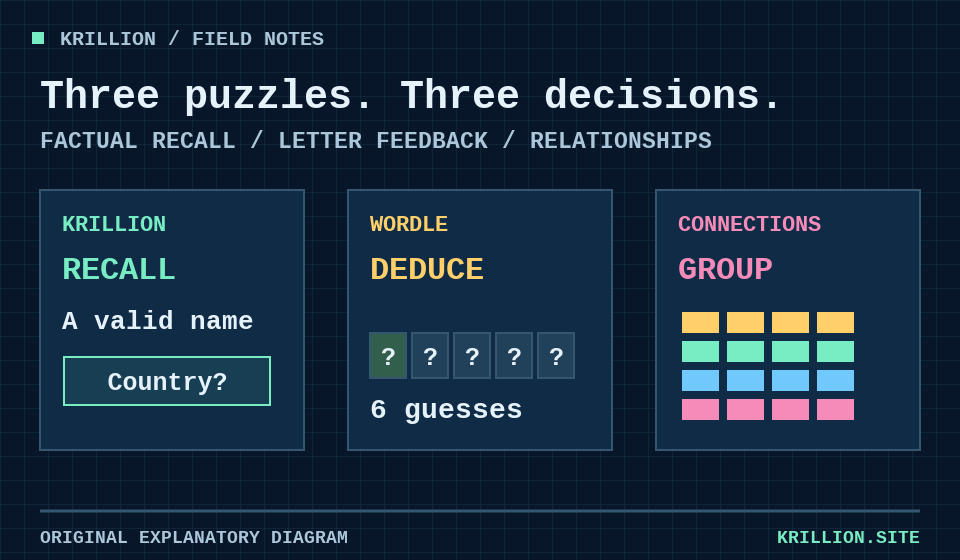
Krillion vs Wordle is a comparison between recalling a fact and discovering a hidden word. In this site’s ordinary trivia, a prompt defines a category and you type a qualifying member. Wordle asks for one five-letter target, with up to six guesses and feedback about letters. Knowing a fact is useful in the former; narrowing a spelling space is central to the latter.
Connections introduces a third task: examine sixteen supplied words and find four groups of four with shared relationships. Instead of producing a missing name, you rearrange candidates already visible. These distinctions matter more than a shared daily release. A player can enjoy all three while needing a different mental routine for each.
Recall a member of a category
A trivia prompt might ask for a United Nations member state. There are multiple accepted names, and a capital city answers the wrong kind of question even if it is associated with a member. Begin by checking the boundary, then choose one name you can confidently place inside it. Familiarity affects points only after the name qualifies.
This independent Krillion uses fixed editorial tiers rather than measuring today’s submissions. The ordinary game rewards less familiar listed examples more highly. A real name missing from the bank can be unrecognized, so have a backup while the timer is open. Krillion vs Wordle therefore also involves different recognition systems, not merely different themes.
Deduce a single hidden word
Wordle gives information after a guess, allowing the next choice to test a smaller set of possibilities. A useful habit is to separate confirmed positions from letters that belong elsewhere and letters that have been ruled out. The goal is the hidden word, rather than an unusual word for its own sake.
In Krillion vs Wordle, “be less obvious” is consequently an unreliable universal instruction. An obscure spelling does not win Wordle just because fewer people know it. Likewise, a strong opening word does not establish whether a player won a particular basketball award. Choose a strategy that matches the feedback you actually receive.
Group candidates rather than generate them
Connections places its word set in front of you. The challenge lies in identifying which relationship organizes each group. A word can suggest several associations, so an attractive partial group may compete with another possibility. Reading every candidate before committing helps you notice where a tempting relationship leaves an awkward remainder.
That is different from the naming pressure of trivia. If free recall feels frustrating but you enjoy discussing patterns, grouping may suit the moment. If you prefer showing what you know without visible candidates, naming may be more appealing. Neither experience provides a general ranking of intelligence, and their scores are not interchangeable.
Compare sessions and access separately
Daily describes a release rhythm, not a complete access policy. On this site, the mixed daily has seven shared questions and the NBA daily has its own allocation. Topic practice allows repeated sessions from finite banks. Our date archive reopens genuinely stored schedules, while personal completed records belong to the browser that saved them.
External products control their own archives, subscriptions and additional modes. Follow their official links for current availability instead of assuming that an option here exists there. A Krillion vs Wordle comparison should distinguish the thinking task from the purchase decision; this guide does not claim every archive or unlimited mode is free.
Choose a social format that actually exists
People can discuss a daily puzzle after separate attempts, solve together on one screen or join a live multiplayer room. Those are three different formats. This site’s private trivia rooms give invited participants shared questions, while solo daily attempts remain separate. Posting a result does not itself create a room.
For a small group, first agree whether answers may be discussed during play. If everyone wants an individual first attempt, share a dated link without answer screenshots. If collaboration is the point, consider whether recalling names or explaining relationships gives everyone a useful role. Let the group’s preferred activity guide the choice.
Use an original three-task exercise
Try three untimed paper tasks: name a country you can place in the correct membership category; think of a five-letter word and let a friend test guesses; then sort Apple, Pear, Cat, Dog, Red, Blue, Circle and Square into four pairs. These invented exercises illustrate retrieval, deduction and grouping without reproducing any current puzzle.
Notice the point where you wanted more information. Was it a missing fact, feedback about a guess or a relationship among visible choices? That observation gives the Krillion vs Wordle decision a practical basis. It is more informative than comparing completion times from entirely different rule systems.
Pick the next game by what you want to practise
Choose factual naming when you want to retrieve teams, films or places. Choose hidden-word deduction when you want to use constraints across successive guesses. Choose grouping when you enjoy alternative interpretations of the same visible words. If you want common answers instead of rare ones, Noillirk changes the naming incentive while keeping a different, everyday prompt bank.
After one full session, change one variable in your next choice: subject, decision type or social format. Krillion vs Wordle need not end with one permanent favourite. A short rotation can give each game a role, with clue use and replay clearly distinguished from an unseen daily attempt.
Frequently asked questions
What is the main Krillion vs Wordle difference?
Here you recall a qualifying factual name from a category. Wordle asks you to deduce one hidden five-letter word using feedback.
Does Krillion use coloured letter tiles?
No. An entry is checked against the current factual question’s reviewed names and aliases, then scored if accepted.
How does Connections differ?
Its sixteen supplied words must be organized into four related groups. You select among visible candidates rather than type a recalled name.
Which game is easier?
That depends on the topic and your preferences. Different tasks and scoring systems do not provide a universal difficulty ranking.
Can I play all three on this website?
Only our independent trivia is hosted here. The official NYT links lead to Wordle and Connections on their own site.
Does unlimited mean no repeated questions?
No. Our repeatable practice draws from finite pools. Repeated starts can revisit prompts.
Which option rewards common answers?
Our Noillirk balloon game rewards familiar listed answers. Its daily and unlimited sessions use their own everyday prompts.
Is a shared result a multiplayer room?
No. Sharing compares finished attempts. A live room requires its own invitation and synchronized trivia session.
Sources & further reading
An original Krillion field note. Reviewed . Illustrations are original explanatory diagrams. Exercises are editorial suggestions, not measured learning outcomes or player answer frequencies. External products run on their own sites.