Wonderhop vs Krillion vs Noillirk: four answer goals explained
Understand common, rare, oldest and newest answer goals. Compare Wonderhop with this site’s Krillion and Noillirk without confusing familiarity with factual age.
Try the common-answer Noillirk game ↗
Wonderhop vs Krillion: identify the objective first
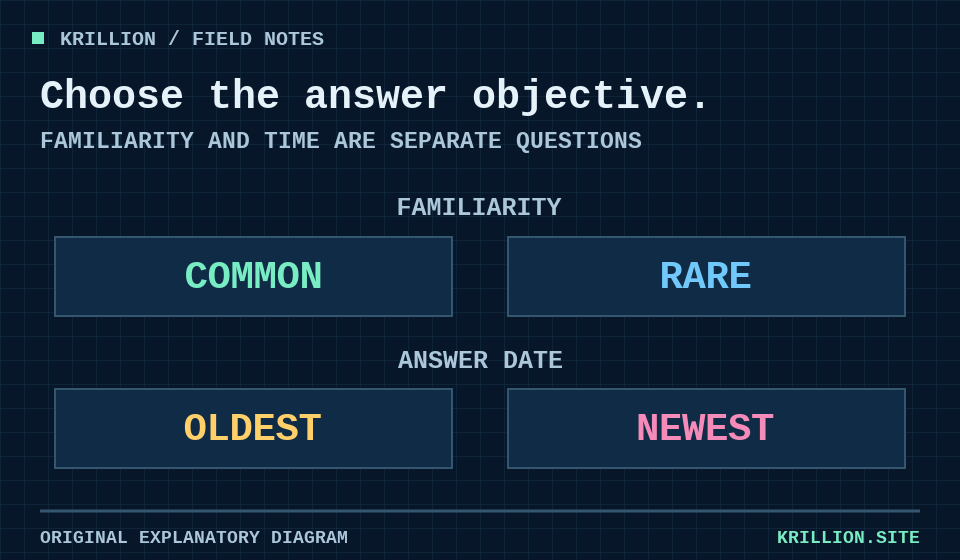
Wonderhop vs Krillion is easiest to understand by asking what makes an accepted answer better. Is the goal to be familiar, overlooked, early or recent? Those objectives can favour different responses to a similar prompt. Looking only at an upward balloon or a downward progress scene can hide that scoring distinction.
Wonderhop’s published rules describe four daily goals: common, rare, oldest and most recent. This independent site’s ordinary Krillion rewards less familiar accepted names; its Noillirk game rewards familiar ones. Our current games do not turn an answer’s historical year into an oldest-or-newest score. That missing mechanism should remain visible in any comparison.
Common-answer play starts with a dependable association
In a common-answer naming game, a familiar association can be useful instead of something to escape. For this site’s Noillirk prompt about a pet, Dog and Cat are reviewed entries near the familiar end of its editorial list. The strategic task is to recognize the everyday meaning of the category and supply a supported name.
That is not permission to ignore the noun. A familiar place does not answer a question asking for a person. Noillirk’s accepted names and aliases are finite, and its familiarity rankings are editorial estimates rather than a measured audience survey. Treat an unexpected score as information about that list, not proof of a universal social preference.
Rare-answer play needs validity before originality
An unusual answer has value only after it qualifies. In ordinary Krillion, a less familiar accepted example can earn a higher fixed tier, but a plausible name outside the reviewed bank can be unrecognized. Keep a clear anchor, consider one alternative and inspect the boundary before submitting. Guessing something obscure is not a substitute for understanding the category.
Wonderhop vs Krillion also requires care around the word “rare.” A product can describe estimates, observed percentages or another scoring method. Our points do not count current player submissions. Read each product’s own explanation before comparing values, and do not interpret 85 points here as an 85-percent statistic.
Oldest and newest need a defined date
A time-based goal needs an event to date. For a film, that might mean a stated release convention; for a console, a particular launch; for an invention, a defined milestone. “Old” is ambiguous until the question specifies what is being measured. A later local release and an earlier premiere can place the same film differently.
Wonderhop advertises Past and Future goals around answer years. That mechanism differs from our questions containing historical windows: a basketball question about awards from 2014-15 to 2023-24 restricts membership, but our score still uses familiarity. Merely displaying dates does not make a game an oldest-answer challenge.
One invented example separates the two axes
Imagine a classroom exercise with three fictional machines: Lantern released in 1980, Comet in 2000 and Pebble in 2020. Lantern is oldest and Pebble newest regardless of which one a class knows best. If most classmates know Comet, familiarity would favour a different answer from either endpoint of that timeline.
The machines and dates are invented solely to explain the distinction; they are not questions or rankings from Wonderhop. This is the central Wonderhop vs Krillion lesson: age and familiarity can move independently. A famous old item can be both common and early, while an obscure recent item can be rare and new.
Compare the actual session rules
On this site, ordinary solo trivia uses seven rounds with a three-second preview and a twenty-second answer window. Noillirk uses eight prompts, twenty seconds each, and its own daily or unlimited flights. It does not simply reverse the same seven factual questions; the everyday prompts and save state are separate.
Wonderhop publishes its own timing, reset timezone and access rules. Those should not be copied from this site’s UTC daily. In Wonderhop vs Krillion comparisons, follow the official rules before planning a shared session. A date on two different sites can identify different release windows even when both products call their game “daily.”
Move between goals without carrying the wrong habit
When switching from rare to common play, pause before discarding your first sensible answer. When switching toward rare play, retain that first answer as a backup while searching for a defensible alternative. When switching toward an age goal, identify the relevant date instead of asking whether the name sounds surprising.
A short note beside your screen can state the active objective in one verb: recall, familiarise, date or compare. The wording is an editorial memory aid, not a feature required by any product. It prevents the familiar mistake of making a clever decision for yesterday’s game instead of a useful one for the current round.
Choose a product by the experience it currently offers
Try our Noillirk if you want an everyday common-answer balloon game, or our mixed and themed practice if factual categories and rare-answer tiers appeal. Use Wonderhop’s official site when you specifically want its four-goal system. This site does not host its rounds, transfer its results or claim an official connection.
Wonderhop vs Krillion should leave you with a concrete choice rather than a winner declared from unrelated scores. Match the goal, question style and session rules to the activity you want. If the aim is to learn from a factual miss here, a dated answer explanation may be more useful than immediately changing games.
Frequently asked questions
What does Wonderhop vs Krillion compare?
Their answer objectives and rules. This site currently offers familiar- and rare-answer naming, while Wonderhop also describes oldest and newest goals.
Is Noillirk just the same trivia with reversed points?
No. Our standalone Noillirk has eight everyday prompts and its own bank and saves. The factual reverse-practice entrance is a separate mode.
Does rare mean historically old?
No. Familiarity and age are independent properties. A famous old item can be common; a little-known new item can be rare.
Does an award date make this an oldest-answer game?
No. Our dates constrain which winners qualify. The awarded points still come from fixed familiarity tiers.
Are the fictional machines real game answers?
No. They are an original explanatory example, not an extracted puzzle or accepted list from an external product.
Are our scores a survey of players?
No. This site uses editorial estimates. External games may describe their values differently; inspect their own methods.
Can I play Wonderhop inside this site?
No. The source link opens its official site. This article is an independent comparison.
Do all the games reset at the same time?
No. Our shared daily uses UTC. Check each external product’s published timezone rather than assuming the calendars match.
Sources & further reading
An original Krillion field note. Reviewed . Illustrations are original explanatory diagrams. Exercises are editorial suggestions, not measured learning outcomes or player answer frequencies. External products run on their own sites.