No-repeat trivia strategy: save flexible answers for later
Learn how answer reuse changes trivia strategy. Try a three-round original fruit exercise, understand shrinking choices and distinguish it from our ordinary game.
Try ordinary rare-answer practice ↗
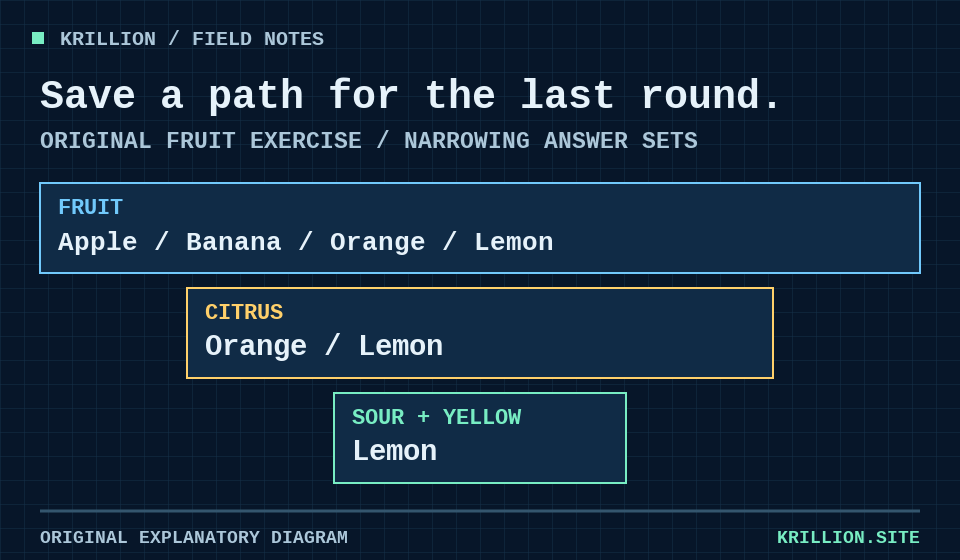
No-repeat trivia adds a cost to a correct answer
No-repeat trivia asks you to consider not only whether a name qualifies now, but whether spending it removes a useful choice later. A correct answer can therefore be locally sensible and strategically expensive. This differs from ordinary independent rounds, where a name is judged for the current prompt without a whole-game reservation ledger.
Kabloom’s published rules describe seven questions on one subject and an answer usable only once across a climb. This article uses that broad distinction for comparison, then supplies an original three-round teaching exercise. The exercise is not Kabloom’s daily, does not reproduce its answer lists and does not turn our normal practice into a full no-repeat mode.
Find the answer that has fewer substitutes
Imagine one question allowing many fruits, another allowing citrus and a final one asking for a sour yellow citrus fruit. Apple works in the broad first set but not the narrower later sets. Lemon can cover all three in this deliberately small example, so spending it first removes an option that is difficult to replace.
The useful principle in no-repeat trivia is flexibility, not fame. A familiar answer might be essential later, but an obscure answer can be equally valuable if it satisfies many narrow conditions. Prefer a valid early candidate with fewer potential future jobs when the available information supports that judgement.
Try the three-round original exercise
The exercise below offers four explicit names: Apple, Banana, Orange and Lemon. Its three prompts narrow from fruit to citrus to sour yellow citrus. It is untimed, shows its small allowed lists and keeps your used names only while this component remains open. Its teaching goal is to make the cost of an earlier choice visible.
Choose a fresh name for each step. Apple, Orange, Lemon is one successful route; Banana can replace Apple. If you spend Lemon too early, the final step has no fresh eligible answer. Restart to compare paths. These categories are defined for this exercise, not as an exhaustive botanical classification or a promise about another game’s matcher.
Separate a used answer from an invalid one
A no-repeat trivia interface can reject a name for different reasons: it does not belong to the current category, it is absent from the supported list, or its canonical identity has already been used. Those cases call for different responses. A new spelling cannot make an already spent identity available again.
For example, the teaching exercise maps Apples to Apple and Lemons to Lemon before checking use. The plural is not a second resource. Real products maintain their own alias rules, so inspect their feedback rather than assuming a nickname will bypass a restriction. This is a game-planning constraint, not a spelling contest.
Plan with the information actually available
The exercise reveals all three future prompts to isolate the planning problem. A real daily may show only the current question. In that case you cannot guarantee the perfect allocation from hidden information. Use the subject and known rules as clues, preserve flexible candidates where reasonable and keep a backup rather than pretending you can predict the exact finale.
After a failed attempt, review the complete question sequence if the product publishes it. Identify the first choice that removed a later option. No-repeat trivia review becomes specific when you can say “this early slot had alternatives, but that later slot did not.” Simply collecting more unusual names may not address the allocation mistake.
Use a compact paper ledger
For a cooperative practice session, make a small ledger with the canonical answer, the question that spent it and one remaining alternative. Keep the notation short enough to scan. If a group says the same name in different forms, merge them immediately so the list reflects resources rather than spelling variants.
A ledger is an editorial practice suggestion, not a claim that every timed game allows external notes. Follow the rules of the session you are playing. In ordinary Krillion here, names are not reserved globally across a seven-round run, so importing the ledger constraint would be a self-imposed exercise rather than the implemented scoring system.
Avoid overplanning past the clock
A sound no-repeat trivia strategy still needs a submitted answer. Do not spend so long predicting future categories that the current timer expires. Establish a valid low-cost choice, glance at your remaining options and commit while you can act. When uncertain, distinguish a plausible future risk from an immediate guaranteed timeout.
The teaching exercise is intentionally untimed so you can compare paths without that pressure. Kabloom and other external products set their own clocks and failure rules. The source link below is the place to check them; this article’s fruit exercise neither simulates every rule nor shares any external result or account.
Know what you are playing on this site
Our full trivia game currently supports shared daily questions, topic practice, dated replay and private rooms. Its ordinary solo rounds do not enforce a whole-run prohibition on reusing an accepted name. The small exercise on this page does, but it has three fixed prompts, no score, no timer and no saved history.
That boundary lets you study no-repeat trivia without mistaking a blog illustration for a newly released daily product. Use the exercise to learn allocation, ordinary practice to review factual boundaries and an external game’s official site for that product’s full challenge. Each route serves a different purpose.
Frequently asked questions
What is no-repeat trivia?
A challenge where an accepted canonical answer can be spent only once across the specified sequence, so earlier choices affect later options.
Is the fruit exercise a full new game mode?
No. It is an original, untimed three-round teaching exercise inside this article, with four names and no score or persistent history.
Is it today’s Kabloom?
No. The example is independently written and does not reproduce any external daily board or its answer lists.
Why save Lemon?
It is the only allowed answer to the final prompt in this example. Earlier prompts can use alternatives, so saving it preserves a complete path.
Can I reuse the plural of an answer?
No. The exercise normalizes supported plurals to the same identity. An alias does not replenish a spent answer.
Does a wrong attempt use up a name here?
No. Only an accepted fresh choice advances the exercise and enters its used list. A rejected choice leaves the current step open.
Can I know every future question in a real daily?
That depends on the product. This exercise reveals them for teaching; a sequential daily may keep later prompts hidden.
Does regular Krillion ban all repeated answers?
No. This site’s ordinary rounds do not reserve accepted names across the entire run. The blog exercise has its own small reservation rule.
Sources & further reading
An original Krillion field note. Reviewed . Illustrations are original explanatory diagrams. Exercises are editorial suggestions, not measured learning outcomes or player answer frequencies. External products run on their own sites.